How much does it cost to develop a mobile application?
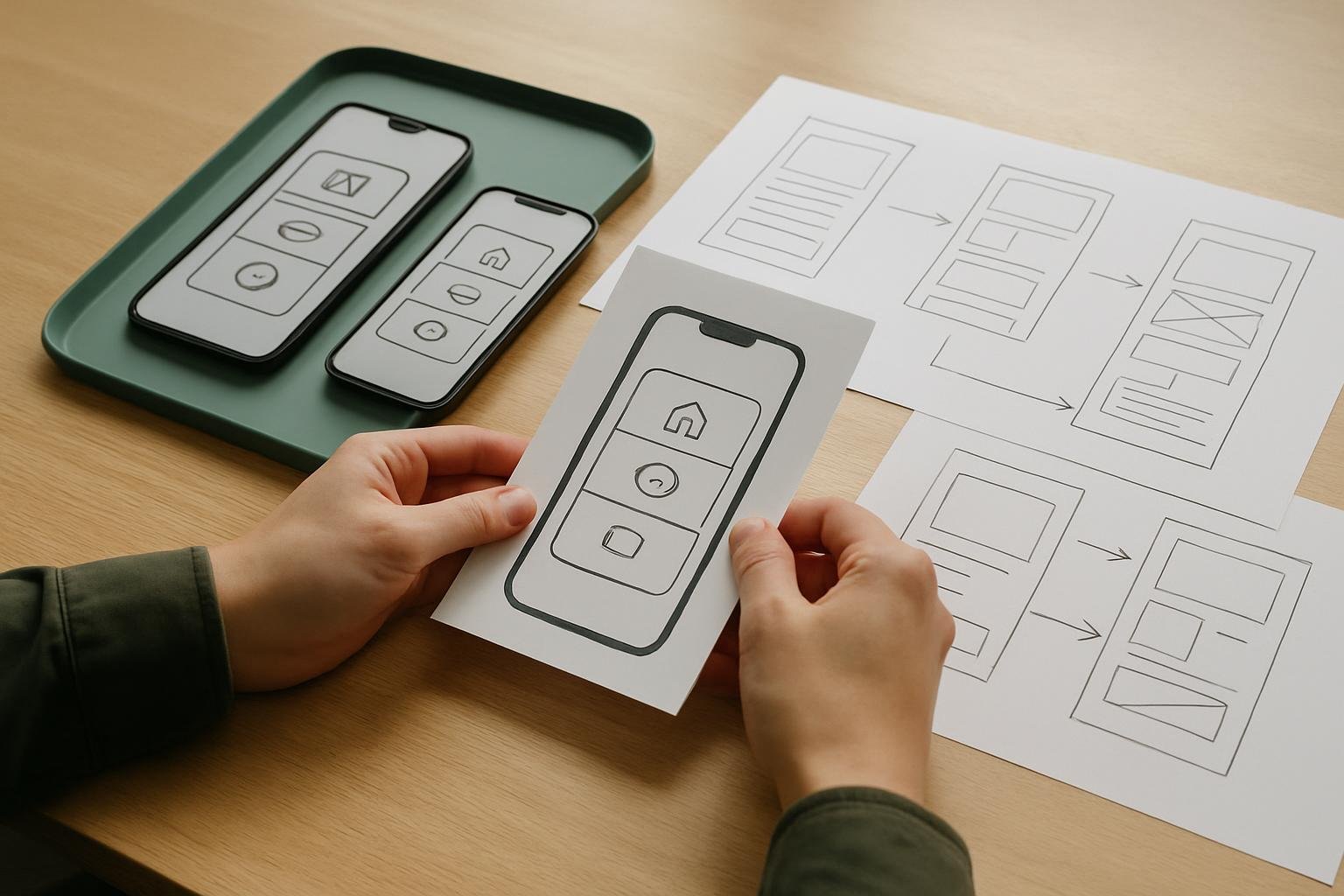
A mobile application's development cost comes from the work needed to deliver its agreed scope. As a purely illustrative calculation, 60 delivery days at 600 pounds a day gives a build budget of 36,000 pounds. Those are hypothetical inputs, not a market average or supplier quote. Your estimate needs to account for the app, its supporting systems, testing and release, with running costs budgeted separately.
The useful question is what your money buys: a demonstration, a narrowly scoped first release, or a product ready for customers and support staff to depend on. Compare those deliverables before comparing headline prices.
Turn the idea into work that can be priced
A screen count is a weak basis for estimating an app. A booking screen could display available appointments, or it could coordinate staff schedules, take payment, handle cancellations and prevent two customers reserving the same slot. Similar-looking interfaces can conceal very different engineering work.
Describe the complete task instead. For a booking app, that might be: a customer chooses a service, sees current availability, reserves a slot and receives confirmation. Then define what happens when payment fails, the connection drops or availability changes before confirmation.
Ask for an estimate organised around deliverables rather than a single development total. It should distinguish:
- Discovery and design: clarifying requirements, investigating technical risks, designing journeys and agreeing how completion will be assessed.
- Application and supporting systems: the mobile interface, server-side logic, data storage, integrations and any administration tools.
- Verification and release: automated checks, device testing, accessibility testing, security review, user acceptance and launch preparation.
Check your organisation's contribution too. Content preparation, access to existing systems, staff testing and prompt decisions all need an owner. If nobody has capacity for those tasks, allow for additional supplier involvement rather than assuming they will happen for free.
A worked budget, not a price promise
Here is one way to examine the hypothetical 60-day budget. Assume a tightly scoped app with an online-only workflow, limited user roles and one understood integration. The allocation below illustrates budgeting arithmetic, not an estimate of how long your project should take.
- Discovery and technical investigation: six days.
- Journey design and interface design: eight days.
- Mobile app, supporting services and administration: 28 days.
- Testing, corrections and user acceptance: 12 days.
- Release preparation, documentation and handover: six days.
At the invented blended rate of 600 pounds per day, that totals 36,000 pounds. If an unresolved requirement adds ten delivery days, the same calculation adds 6,000 pounds. This shows why reducing uncertainty matters as much as negotiating the daily rate.
Keep a contingency allowance separate from the agreed work, and connect it to named risks. An untested integration deserves investigation, not an unexplained buffer. Also confirm whether tax, external services, hosting and post-launch changes are included. Delivery days represent effort, not elapsed calendar days or a promised launch date.
Which requirements change the cost most?
Platform coverage and device behaviour
Separate native apps involve platform-specific development. A cross-platform approach shares application code, but still needs testing on each supported platform. Neither choice removes work on the database, business rules or administration area. Ask the supplier to explain which work is shared and which remains platform-specific.
Price the difficult device requirements early: background activity, camera workflows, location tracking, Bluetooth accessories or demanding graphics. A small technical trial can help establish whether the proposed approach fits. If users mainly need forms and account information, assess whether a mobile-friendly web application would meet the need before funding an installed app.
For the broader suitability decision, the guide to mobile app development for business explains how to assess the build approach. For budgeting, request a comparison against your actual requirements rather than a claim that one technology is universally cheaper.
Offline use and synchronisation
Displaying previously downloaded information is a different requirement from letting people edit records offline. Editing needs rules for storing changes, retrying transfers and resolving conflicts when two people alter the same record. Include visible status messages so users know whether their work is saved locally or received by the server.
Integrations and administration
An application programming interface, or API, allows systems to exchange information. Its existence does not establish that your required workflow is supported. Before accepting a fixed integration price, ask the developer to inspect documentation, access arrangements and representative data, then test the riskiest action.
Include the staff side of the product. Someone may need to correct bookings, manage accounts, answer support queries or review failed transactions. Leaving administration out can make the initial quote smaller while leaving staff dependent on developers for routine work.
Reduce the first release without weakening it
A minimum viable product, or MVP, should test a defined assumption through a limited working product. For an appointment app, that might mean proving that customers will book and return. It does not necessarily require loyalty points, chat, advanced reporting and several payment options at launch.
Reduce the number of supported journeys before removing safeguards. Account access controls, appropriate data protection, recoverable failures and testing of the main task still matter. A narrower first release should do less, not leave essential behaviour unfinished.
One platform or a controlled pilot group may be appropriate if it represents the users you need to learn from. The recommendation changes if excluding a platform would exclude a substantial part of your intended audience. Record that trade-off rather than treating a smaller launch as automatically sensible.
Budget for keeping the app useful
Separate the cost of operating the current product from developing new features. Operating costs can include hosting, storage, monitoring, backups, external service usage and support. Maintenance covers work such as dependency updates, compatibility checks and correcting defects. Feature development needs its own allowance and priorities.
Request a first-year operating forecast with assumptions about active users, file storage and transaction volume. Ask which charges rise with usage. Agree who receives failure alerts, who investigates them and what support is available outside normal hours. A monthly fee means little without those boundaries.
FullyCoded builds apps for iOS and Android, including the web platforms and APIs behind them. Its process starts with discovery to establish scope and an estimate before the build. The digital product and app development page is a relevant next step if you want to discuss that scope.
Compare quotes against the same release
Give each supplier the same brief: priority journeys, supported platforms, offline needs, integrations, administration tasks and acceptance criteria. Ask each to identify exclusions, unresolved assumptions and the basis of the price. Clarify whether it is a fixed commitment, an estimate or a spending cap, and how changes are approved.
Before signing, agree ownership and access for source code, infrastructure, release accounts and documentation. Establish who signs off the work, what happens if testing finds defects and how another team could take over. Then compare the total cost of delivering and operating the same release, not simply the lowest number on the proposal.